Joseph Grotowski: [email protected]. 06-206 (Tues 10-12, Thurs 11-12, or by appointment).
This course is compulsory for many students. Its prerequisites are MATH2000 and MATH2400 (or equivalents). This is the capstone course for math majors and math undergraduate degrees.
The techniques and problem solving strategies in this course will be beneficial in many ways.
Lecture recordings will be on the Blackboard. Tutorials start in week 1.
The best 5 of 6 assignments together count for 20%. The midsemester counts for 20% (one page of handwritten notes is allowed, single-sided). The final exam counts for 60% (one page of handwritten notes, double-sided).
A ‘nice’ result which shows all different parts of maths coming together: e^{i\pi} = -1.
There are a number of fascinating things about this equation. Despite i not appearing in this expression, it still delves into complex analysis.
\int_{0}^\infty \frac {\sin x} x \,dx = \frac \pi 2
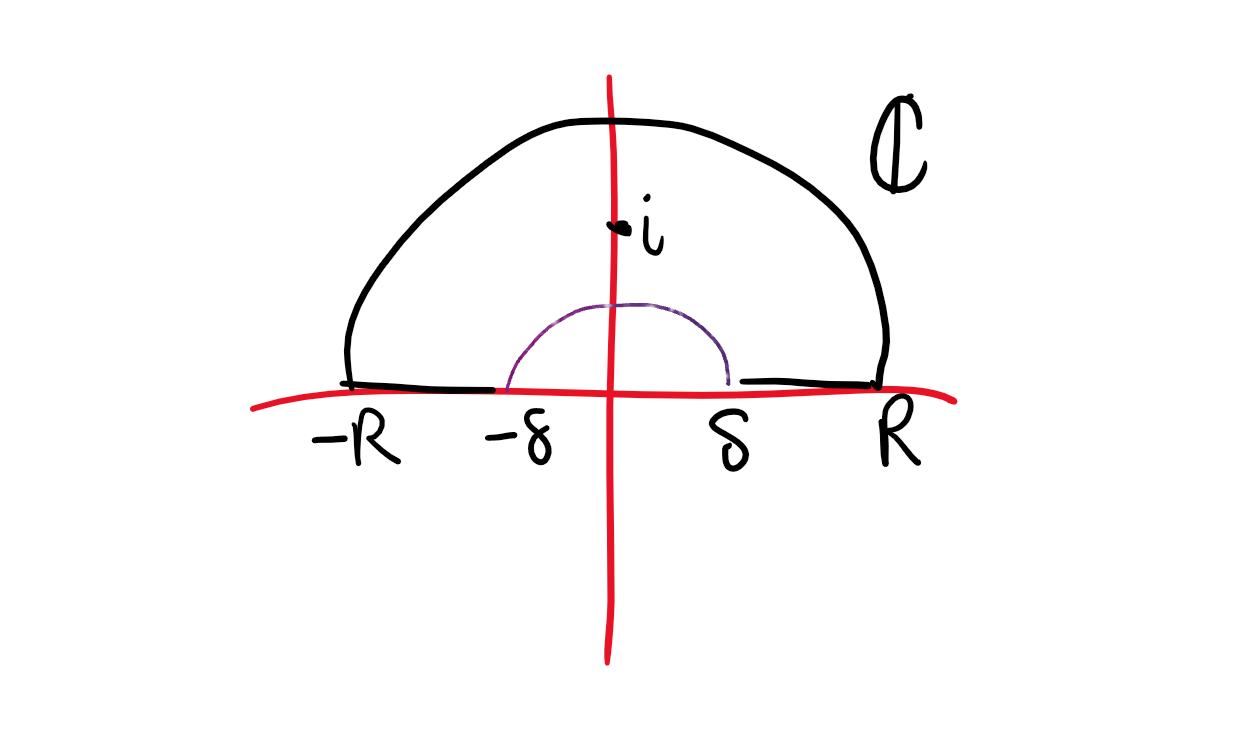
A reasonable question is does this integral even converge? If we replace \sin x with 1, the integral diverges by the p-test. Arguing the integral exists is a bad time without complex analysis, but is really really nice with complex. This will be done towards the end of the semester, making use of contour integrals around a path in the complex plane.
In the more applied realm, we can also do things with fluid flow. A very expensive method would be constructing a physical model then running experiments. 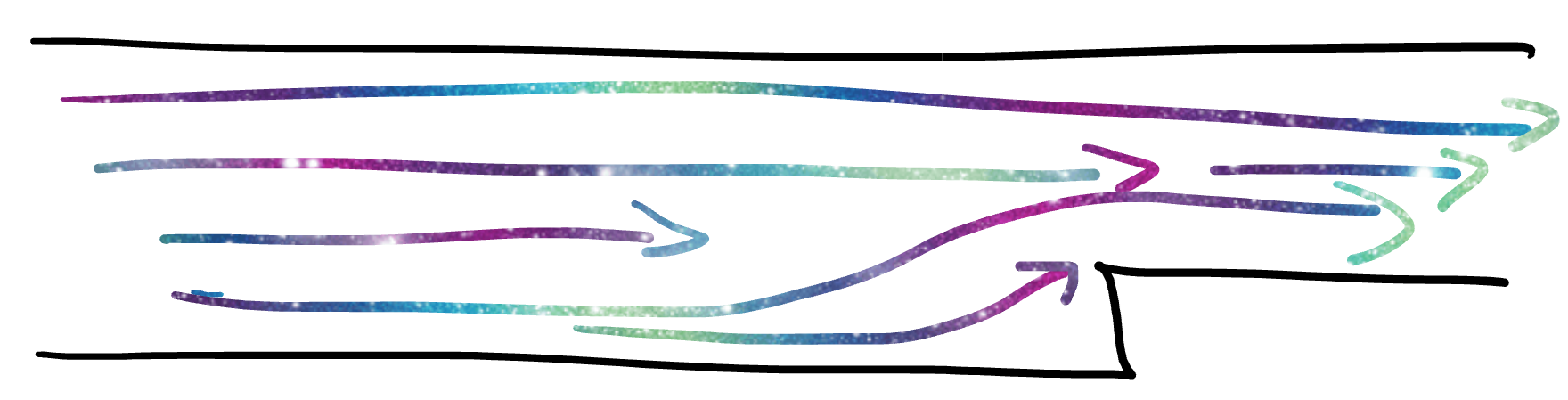 With complex analysis, we can perform analysis on a straight pipe, then map to the pipe above without having to build the channel. We can just tweak the parameters in the map to test different scenarios. This is called a conformal transoformation.
Similarly, Joukowski transformations can be used to model air flow around a wing. 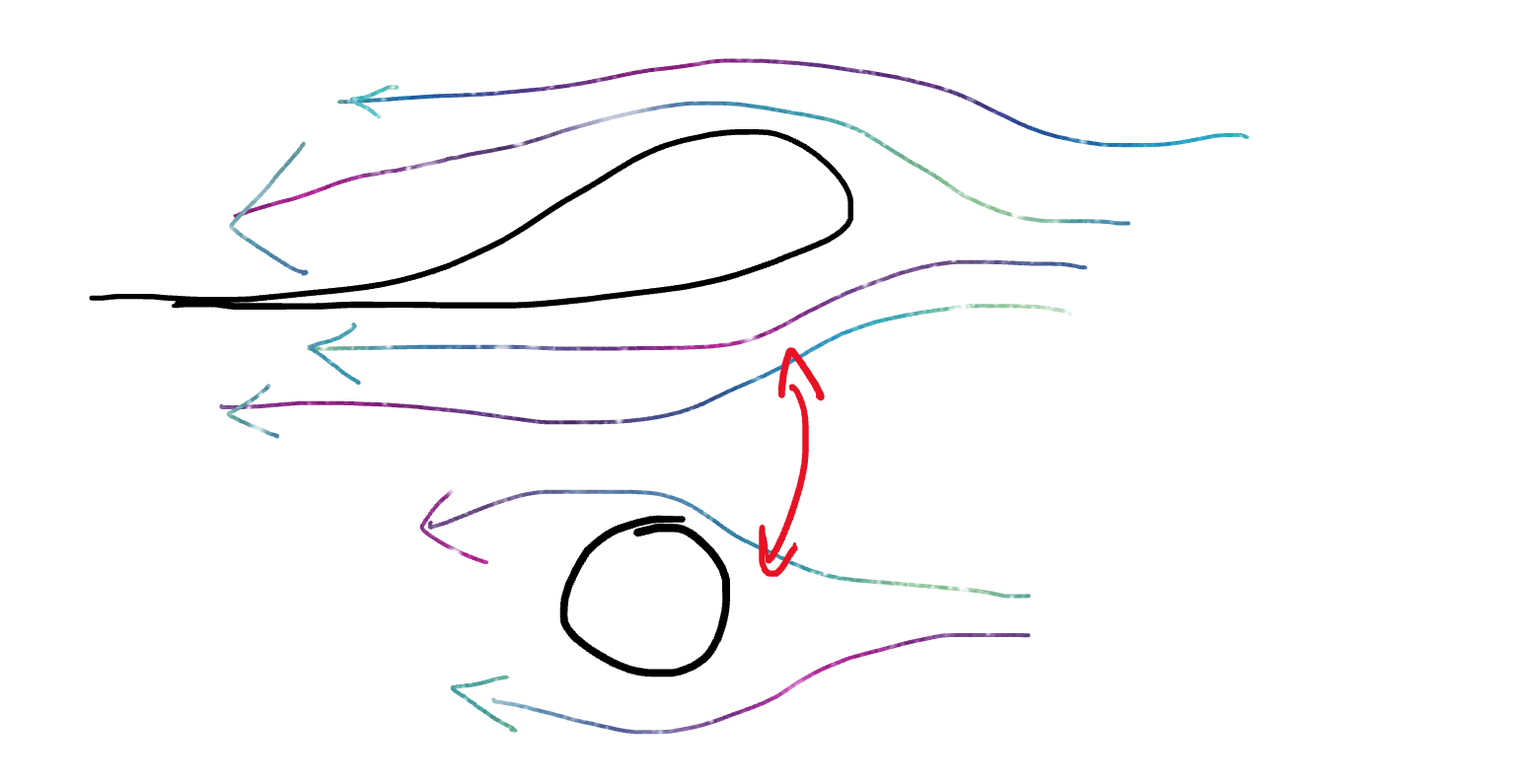
We can also get nice results about series like \begin{aligned} \frac 1 {1^2} + \frac 1{2^2} + \frac1 {3^2} + \cdots &= \frac {\pi^2} 6 \\ \frac 1 {1^2} - \frac 1{2^2} + \frac1 {3^2} - \frac 1 {4^2} +\cdots &= \frac {\pi^2} {12} \\ \sum_{k=1}^\infty \frac 1 {1 + 4 k^2 \pi^2}& = \frac 1 2 \left(\frac 1 {e-1} - \frac 1 2\right) \end{aligned}
\zeta (s) = \sum_{n=1}^\infty \frac 1 {n^s} = \prod_{p\ \text{prime}}(1-p^{-s})^{-1} (The product of primes result is from Euler. This is called the Riemann zeta function)
Riemann hypothesis: \zeta has infinitely many non-trivial zeros and they all lie on the line \text{Re}(s) = 1/2.
Note that the expression for \zeta only makes sense for \text{Re} s) > 1, so we need to extend it to \mathbb C via analytic continuation. In doing this, the trivial zeros are -2, -4, -6, \dots