Definition. The boundary of \Omega, denoted \partial \Omega, is defined as \{z \in \mathbb C : z \text{ is a boundary point}\}.
Recall that interior points are in \Omega and exterior points are in \Omega^c. What about the boundary points?
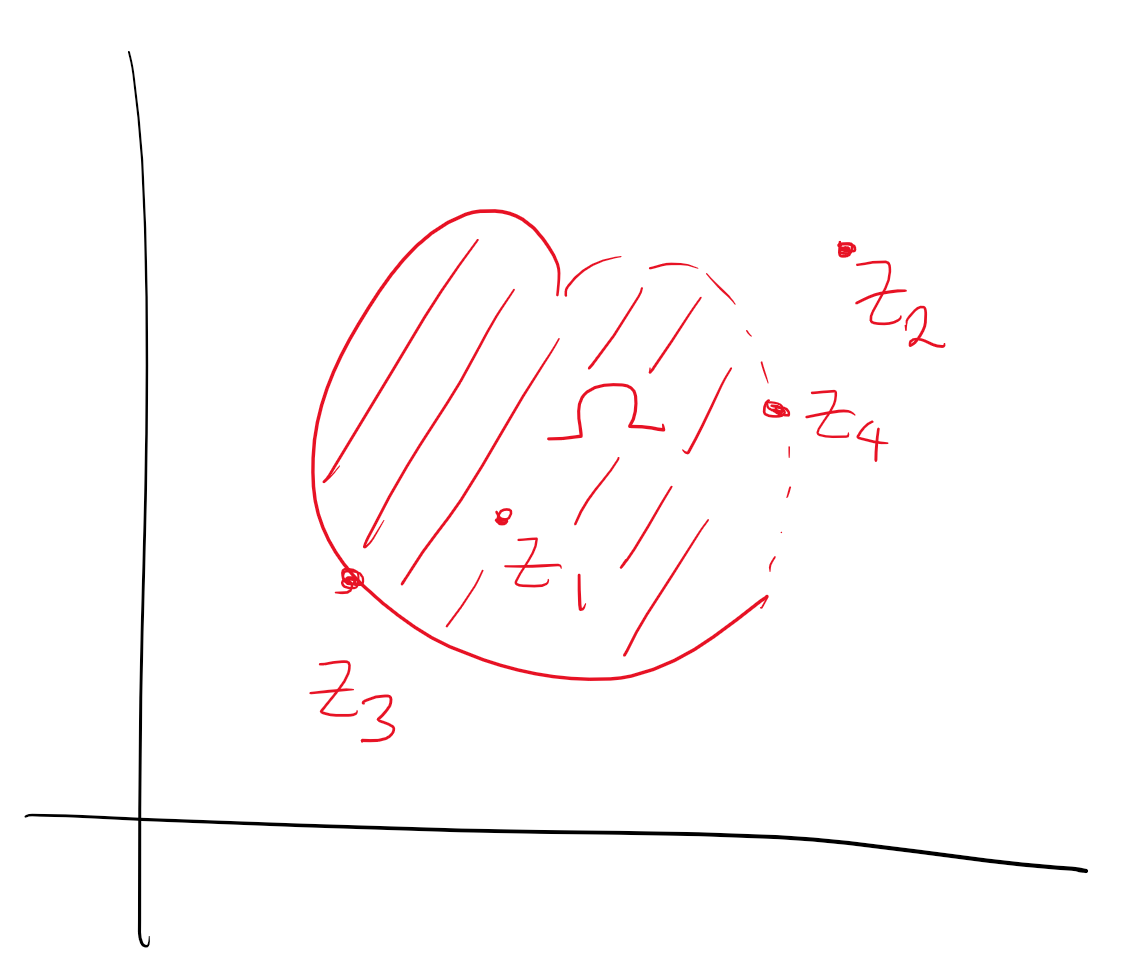
Let’s look at a circle \Omega = \{z : |z| = 1\}. In this case, we have \partial \Omega = \Omega. Let’s consider a blob:
Here, z_1 is an interior point, z_2 is an exterior point, z_3 is a boundary point in \Omega, and z_4 is a boundary point not in \Omega.
Definition. \operatorname{Int}\Omega is the interior of \Omega, the set of all interior points. \operatorname{Ext}\Omega is the exterior of \Omega, the set of all exterior points.
Definition. \Omega is open if \Omega = \operatorname{Int}\Omega, and \Omega is closed if \partial \Omega \subseteq \Omega.
Examples:
Consider the open unit ball, \Omega_1 = B_1(0) = \{z : |z| < 1\}. For this set, \operatorname{Int} \Omega_1 = \Omega_1, \operatorname{Ext}\Omega_1 = \{z : |z| > 1\}, \partial \Omega_1 = \{z : |z| = 1\}. Note that this means \Omega_1 is open.
Consider the closed unit ball, \Omega_2 = \overline{B}_1(0). Here, \operatorname{Int}\Omega_2 = \Omega_1, \operatorname{Ext}\Omega_2 = \operatorname{Ext}\Omega_1, and \partial \Omega_2 = \partial \Omega_1. This means \Omega_2 is closed.
Consider \Omega_3 = \{z : 0 < |z| \le 1\}. \operatorname{Int} \Omega_3 = \{ z : 0 < |z| < 1\}, \operatorname{Ext} \Omega_3 = \operatorname{Ext} \Omega_1, \partial \Omega_3 = S^1 \cup \{0\}. This is neither open nor closed.
Note that \Omega_1 is open and \Omega_1^c is closed. \Omega_2 is closed and \Omega_2^c is open. Both \Omega_3 and \Omega_3^c are neither open nor closed.
Definition. A set which is both closed and open is called clopen.
Definition. A set \Omega \subseteq \mathbb C is called connected if there do not exist non-empty, open, disjoint sets \Omega' and \Omega'' such that \Omega \subseteq \Omega' \cup \Omega'' and \Omega' \cap \Omega \ne \emptyset and \Omega'' \cap \Omega \ne \emptyset.
That is, we can’t find two ‘separated’ sets which together contain all of \Omega and each contain parts of \Omega.
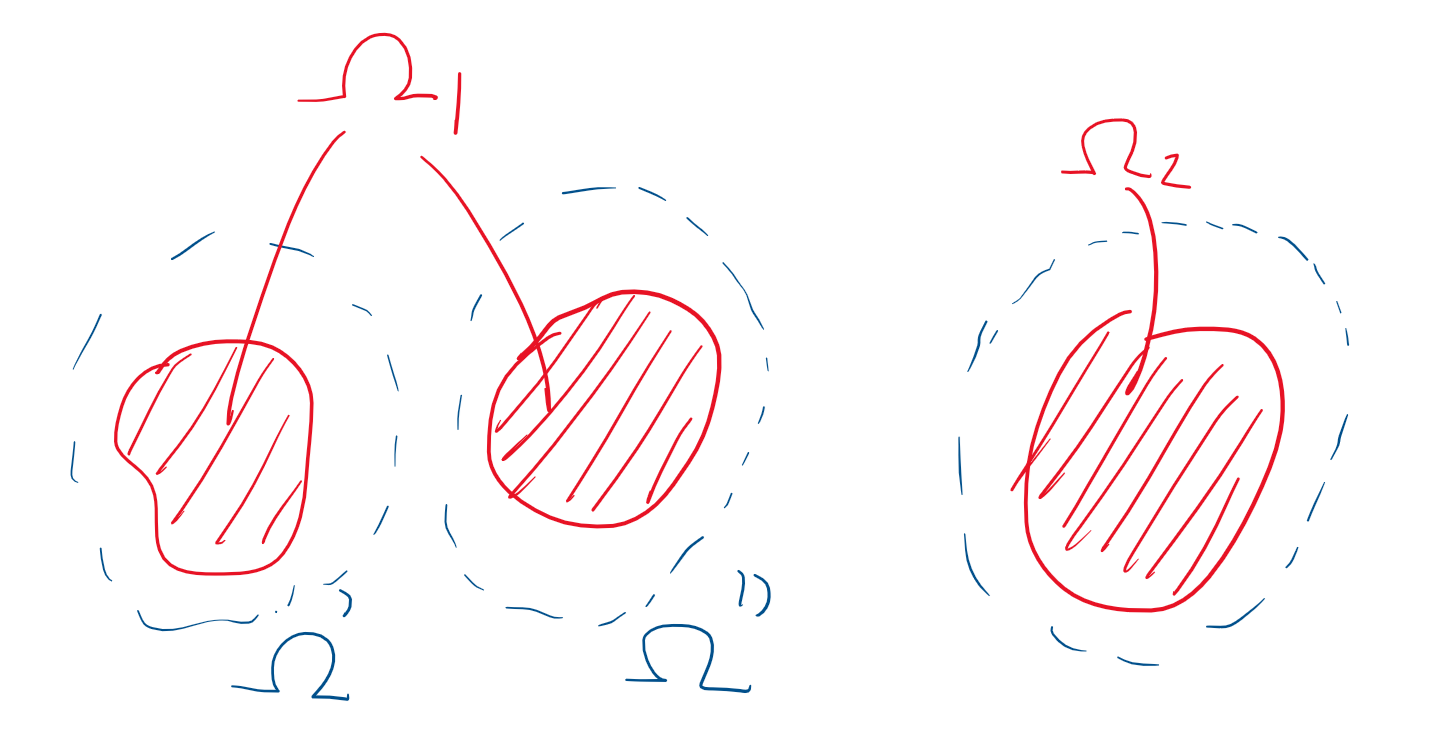
Above, \Omega_1 is disconnected because we can find such \Omega' and \Omega''. However, \Omega_2 is connected.