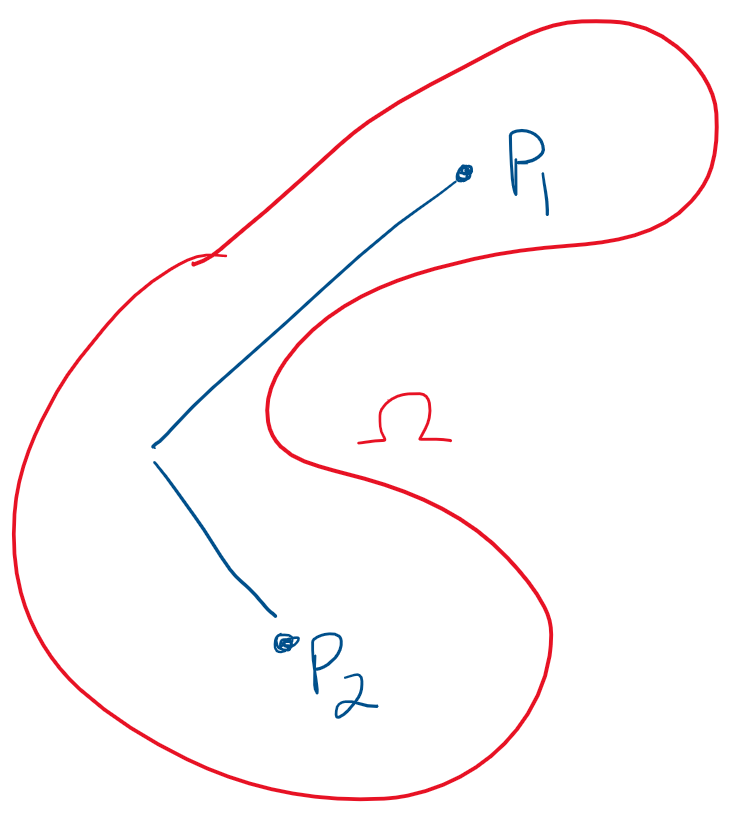
Definition. A set \Omega \subseteq \mathbb C is piecewise affinely path connected if any two points in \Omega can be connected by a finite number of line segments in \Omega, joined end to end.
For open sets in \mathbb C, this is equivalent to the original definition of connected. (This will not be proved in MATH3401.)
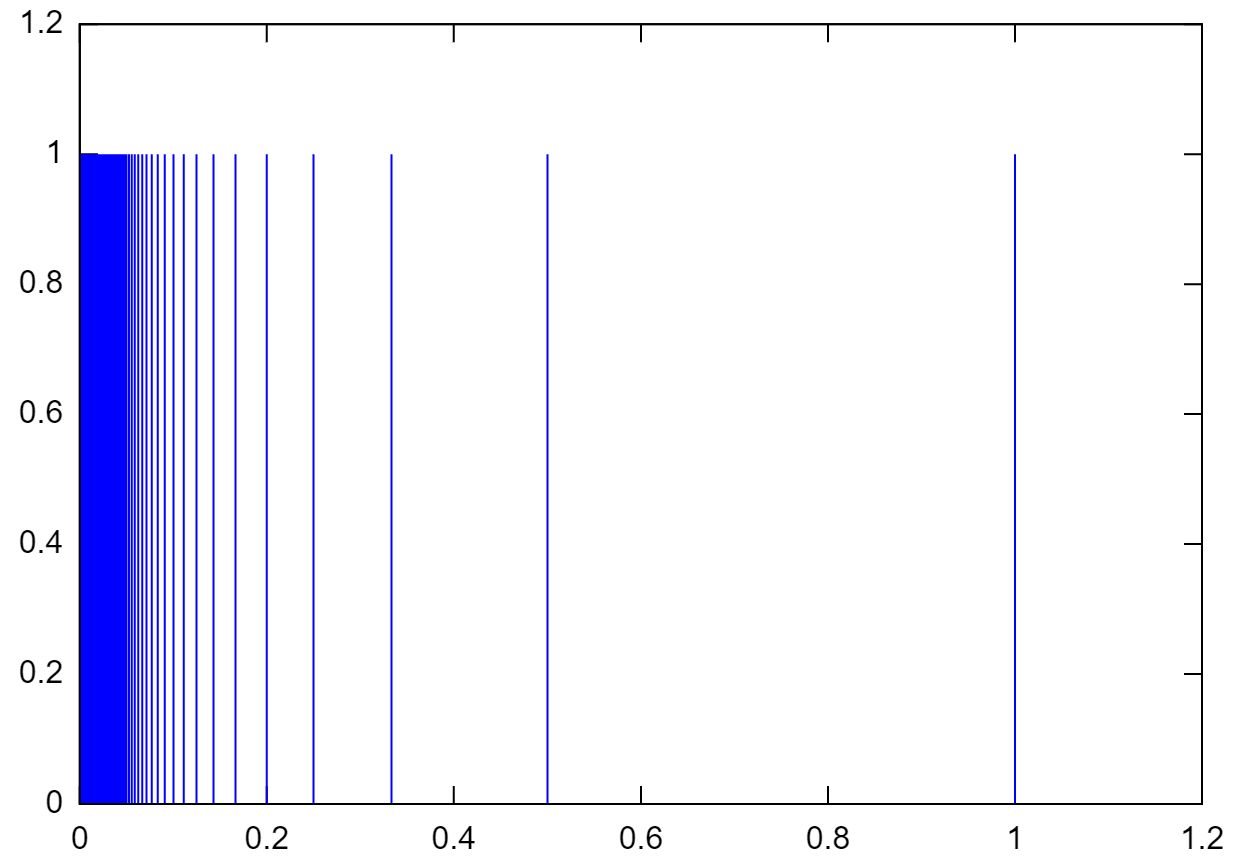
However, it is not so in general. For example, there is a comb space which is connected but not path connected. This is connected because we cannot find open sets
Claim. If \Omega_1 and \Omega_2 are open subsets of \mathbb C, then so is \Omega_1 \cap \Omega_2.
Proof. If \Omega_1 \cap \Omega_2 =\emptyset, then we are done because the empty set is open. Otherwise, for any z \in \Omega_1 \cap \Omega_2, there exist \epsilon_1, \epsilon_2 > 0 such that B_{\epsilon_1}(z) \subseteq \Omega_1 and B_{\epsilon_2}(z) \subseteq \Omega_2. Take \epsilon = \min \{\epsilon_1, \epsilon_2\}. Then, B_\epsilon(z) \subseteq \Omega_1 and B_\epsilon(z) \subseteq \Omega_2 which implies B_\epsilon(z) \subseteq \Omega_1 \cap \Omega_2. Since z was arbitrary and this is the definition of interior point, we see that \operatorname{Int}(\Omega_1 \cap \Omega_2) = \Omega_1 \cap \Omega_2. Therefore, \Omega_1 \cap \Omega_2 is open. \square
Definition. A domain is an open, connected subset of \mathbb C. A region is a set whose interior is a domain.
Definition. A point z \in \mathbb C is called an accumulation point of \Omega \subseteq \mathbb C if any deleted neighbourhood of z intersects \Omega. Note that z need not be in \Omega.
Examples:
B-C 15-16.
Definition. Let f be a complex-valued function defined on a deleted neighbourhood of z_0 \in \mathbb C. Then, we say \lim_{z \to z_0} f(z) = w_0 if for all \epsilon > 0, there exists \delta > 0 such that 0 < |z-z_0| < \delta \implies |f(z) - w_0| < \epsilon. Note that f does not need to be defined at z_0.
Examples:
Remark. If a limit exists, then it is unique.
B-C 17 (8 Ed 16)
Suppose z=x+iy and f(z) = u(x,y)+iv(x,y). Let z_0 = x_0 + iy_0 and w_0 = u_0 + iv_0.
Theorem 1. \lim_{z\to z_0} f(z)= w_0 \iff \begin{cases} \lim_{(x,y)\to(x_0, y_0)} u(x,y) = u_0, & \text{and}\\ \lim_{(x,y)\to(x_0, y_0)} v(x,y) = v_0. \end{cases} Theorem 2. (Non-exciting facts about operations of limits.) Suppose \lim_{z \to z_0}f(z) = w_0, \lim_{z \to z_0}g(z) = \xi_0 and \lambda \in \mathbb C. Then, \begin{align} \lim_{z \to z_0}(f \pm g)(z) &= w_0 \pm \xi_0 \tag{1}\\ \lim_{z \to z_0}(\lambda f)(z) &= \lambda w_0 \tag{2}\\ \lim_{z \to z_0}(fg)(z) &= w_0\xi_0 \tag{3}\\ \lim_{z \to z_0}\frac{f(z)}{g(z)} &=\frac{ w_0}{\xi_0}\qquad\text{ if } \xi_0 \ne 0\tag{4} \end{align} Not that \lim_{z\to z_0}g(z) = \xi_0 and \xi_0 \ne 0 implies g(z) \ne 0 within a neighbourhood of z_0.