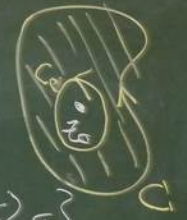
Theorem (Cauchy integral formula). Let f be analytic on and inside a simple closed curve C that is positively oriented (interior is to the left of the curve’s direction). Then, if z_0 \in \operatorname{Int}C we have \begin{aligned} f(z_0) &= \frac 1 {2\pi i} \int_C \frac{f(z)}{z-z_0}\,dz, \quad\text{or}\quad 2\pi if(z_0) = \int_C \frac{f(z)}{z-z_0}\,dz. \end{aligned} This is quite an amazing result. Roughly, f is differentiable and we can know the value of f at a point by the integral of any curve around that point.
Proof. Note that the integrand is not analytic on \operatorname{Int}C because it is not defined at z_0. We will “cut out” this discontinuity so we can apply the Cauchy-Goursat theorem. Set C_\rho = \{z(\theta) = z_0 + \rho e^{i\theta}, 0 \le \theta \le 2\pi\} as a curve around our point z_0, for \rho sufficiently small such that \operatorname{Int} C_\rho \subset \operatorname{Int} C.
We have f(z)/(z-z_0) is analytic on \operatorname{Int}C \setminus \operatorname{Int}C_\rho as well as C and C_\rho. We apply Cauchy-Goursat’s extension to multiply connected domains and that gives us \begin{aligned} \int_C \frac{f(z)}{z-z_0}\,dz &= \int_{C_\rho} \frac{f(z)}{z-z_0}\,dz \\ \implies \int_C \frac{f(z)}{z-z_0}\,dz -f(z_0)\int_{C_\rho}\frac{dz}{z-z_0}&= \int_{C_\rho} \frac{f(z)-f(z_0)}{z-z_0}\,dz \end{aligned} From lecture 20, we know that \int_{C_\rho} \frac{dz}{z-z_0} = 2\pi i because C_\rho is a circle centered at z_0 and this holds for any \rho > 0. Since f is analytic at z_0, it is continuous at z_0 so given \epsilon > 0 there exists \delta > 0 such that |f(z) - f(z_0)|<\epsilon for all |z-z_0| < \delta. Choose \rho < \delta and we will have |f(z_0 + \rho e^{i\theta})-f(z_0)|<\epsilon.
Returning to the equations from above, \begin{aligned} \left|\int_C \frac{f(z)}{z-z_0}\,dz -2\pi i\,f(z_0) \right| &\le \int_{C_\rho} \frac{|f(z)-f(z_0)|}{|z-z_0|}\,dz \end{aligned} Note that all points on C_\rho are exactly \rho away from z_0. Thus, 1/|z-z_0| = 1/\rho. Moreover, the integral \int_{C_\rho} |f(z) - f(z_0)|\,dz is bounded by \epsilon \cdot 2\pi \rho by the M-\ell estimate (here, M is \epsilon and \ell is the circumference of a circle with radius \rho). This gives us, \begin{aligned} \int_{C_\rho} \frac{|f(z)-f(z_0)|}{|z-z_0|}\,dz &= \frac 1 \rho \int_{C_\rho} |f(z) - f(z_0)|\,dz \\ &< \frac 1 \rho \epsilon \cdot 2\pi\rho = 2\pi\epsilon \end{aligned} By sending \epsilon \to 0, we can make this arbitrarily small which tells us \begin{aligned} \left|\int_C \frac{f(z)}{z-z_0}\,dz -2\pi i\,f(z_0) \right| = 0 \iff f(z_0) = \frac 1 {2\pi i}\int_C \frac{f(z)}{z-z_0}\,dz, \end{aligned} as required. \square