We looked at soap film (last year). The key connection is the Neumann boundary conditions. Recall that harmonic functions can be used to minimise some sort of energy function.
In this case, the soap minimises internal potential energy which is done by minimising the surface area of the bubble. This leads to some interesting behaviour for tetrahedral and cubic wire frames with the edges meeting in the middle (as opposed to spanning the face planes).
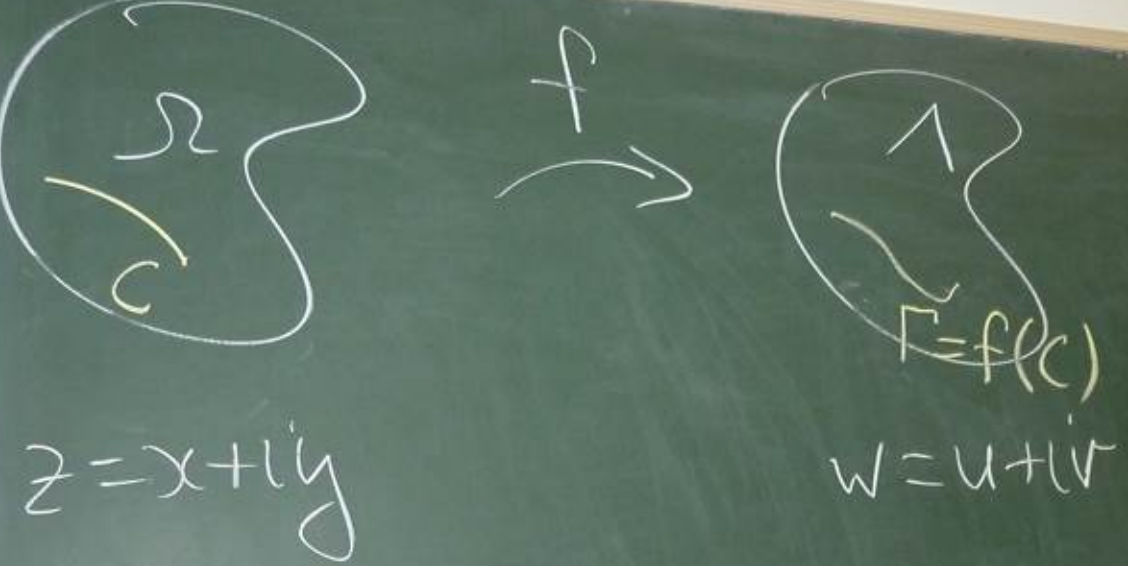
Suppose f is conformal and C is a smooth (infinitely differentiable) arc in \Omega (or on the boundary of \Omega with some care). Let \Gamma = f(C) and H(x,y) = h(u(x,y),v(x,y)).
Example: In \mathbb C (called the w-plane), the function h(u,v)=v=\operatorname{Im} w is harmonic. In particular, it is harmonic on the horizontal strip \Lambda where -\pi/2 < \operatorname{Im}w<\pi/2. We claim that f : z \mapsto \operatorname{Log}z maps \Omega, the right half-plane, onto \Lambda conformally.
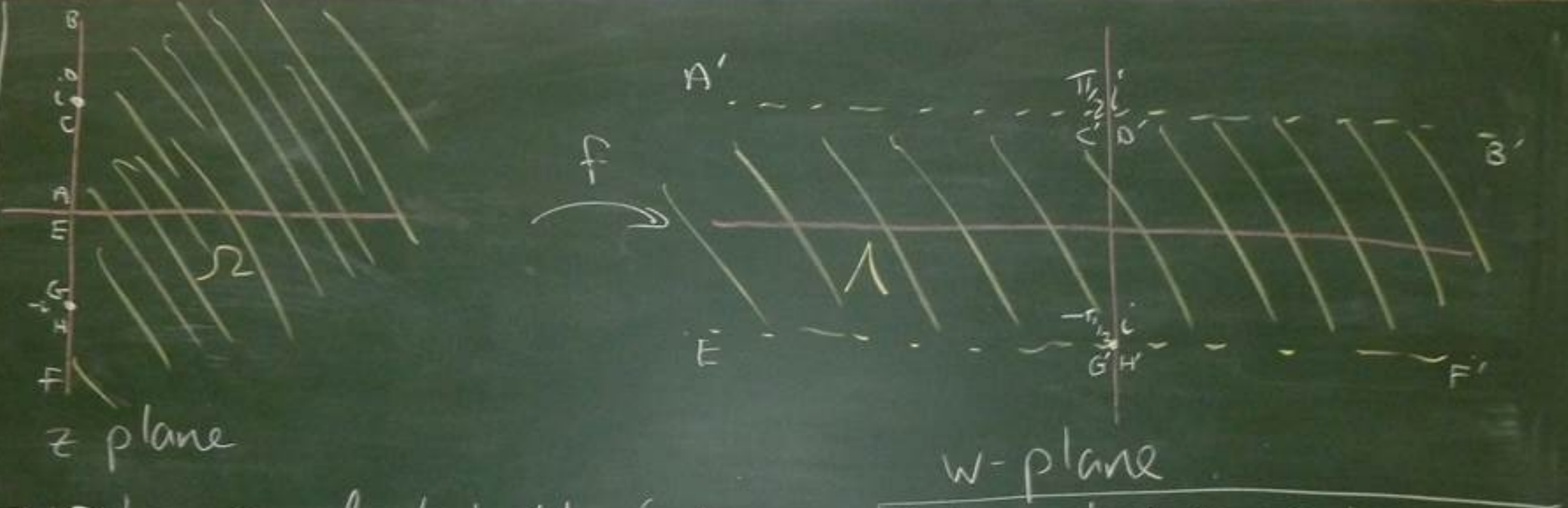
Then, \begin{aligned} z =x+iy\mapsto \operatorname{Log}z &= \ln |z| + i \operatorname{Arg}z \\ &= \underbrace{\ln \sqrt{x^2 +y^2}}_{u} + \underbrace{i\arctan(y/x)}_{iv} \\ \implies H(x,y) &= h(u,v) =\arctan (y/x) \end{aligned} The boundary of \Omega is of the form A = \{0+\delta i : \delta \in \mathbb R\}. Therefore, \begin{aligned} f(A) = \operatorname{Log}A&= \ln |A| + i \operatorname{Arg}A \\ &= \ln |\delta| \pm i\pi/2 \end{aligned} which is exactly the boundary of \Lambda.