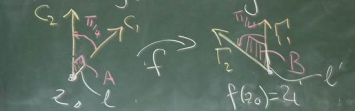
Recall that a conformal map preserves angles, orientations and is 1-to-1. However, it can scale points.
Suppose f : z \mapsto w is a conformal map (i.e. analytic and f'(z_0) \ne 0). For z near z_0 with z \ne z_0, \begin{aligned}\frac{|f(z) - f(z_0)|}{|z-z_0|} \approx |f'(z_0)| \quad\implies\quad |f(Z) - f(z_0)| \approx |f'(z_0)|\,|z-z_0|.\end{aligned} Here, |f'(z_0)| is the scaling factor or dilation factor, i.e. the magnitude of the stretching or shrinking effect.
Example: f(z) = z^2 at z_0 = 1+i (here, z = x+iy and w = u+iv). Then, u=x^2-y^2 and v = 2xy.
Observe that the tangent lines and angles are preserved under f. The scaling factor is |f'(z_0)| = 2|z_0| = 2\sqrt 2. For a small length near z_0, its length will be scaled by a factor of 2\sqrt2. Thus, \ell' \approx 2 \sqrt 2 \ell and also, \operatorname{Area}(B) \approx (2\sqrt 2)^2 \operatorname{Area}(A). This relationship holds regardless of the curves C_1 and C_2, and for all points z_0.
§135 (8 Ed 7§124)
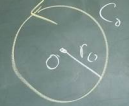
Recall that from Cauchy, if f is analytic in and on C_0, then for z \in \operatorname{Int}C_0, f(z) = \frac1{2\pi i}\int_{C_0}\frac{f(\xi)}{\xi-z}\,d\xi. Recall that for z = re^{i\theta}, r>0, the inverse point to z relative to the circle C_0 is r^*e^{i\theta} with r^* such that r^*r = r_0^2. Also, note that z^* = r^*e^{i\theta}=\frac{r_0^2}re^{i\theta} = \frac{r_0^2}{re^{-i\theta}}=\frac{r_0^2}{\bar z} = \frac{\xi \bar \xi}{\bar z} \quad\text{ for }\xi \in C_0. Now fix z \in \operatorname{Int}C_0 and z \ne 0. Note that \begin{aligned} \int_{C_0} \frac{f(\xi)}{\xi-z^*}\,d\xi=0\quad\text{because}\quad\xi \mapsto\frac{f(\xi)}{\xi-z^*} \end{aligned} is analytic in and on C_0 since z^* \in \operatorname{Ext}C_0 by the Cauchy integral formula. Using this in the above expression, \begin{aligned} f(z) &= \frac 1 {2\pi i} \int_{C_0} \underbrace{\left(\frac 1 {\xi-z}-\frac 1{\xi-z^*}\right)}_{I}f(\xi)\,d\xi \\ I &= \left(\frac \xi {\xi-z} - \frac \xi {\xi - z^*}\right)\frac 1 \xi \\ &= \left(\frac \xi {\xi-z}-\frac 1{1-\bar \xi/\bar z}\right)\frac 1 \xi \\ &= \left(\frac \xi {\xi-z}-\frac{\bar z}{\bar z - \bar \xi}\right)\frac 1 \xi\\ &= \left(\frac{\xi\bar\xi-z\bar z}{|\xi-z|^2} \right)\frac 1 \xi \end{aligned} Recall that z = re^{i\theta}. Put \xi = r_0 e^{i\phi} for 0 \le \phi \le 2\pi. Then, d\xi = r_0ie^{i\phi}\,d\phi. Substituting this into the integrand, \begin{aligned} I &= \frac{r_0^2-r^2}{|\xi-z|^2}\cdot \frac 1 {r_0e^{i\phi}}. \end{aligned} This is mostly in nice radial coordinates except for the |\xi-z| part. Can we rewrite this? Consider the diagram below.
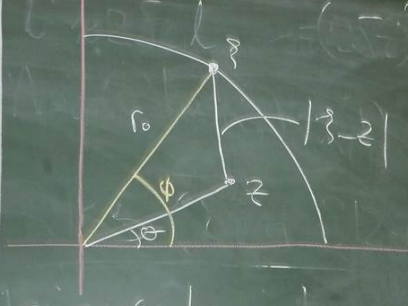
We can appeal to the cosine rule which tells us that |\xi-z|^2 = r_0^2 + r^2 - 2r_0r\cos(\phi-\theta). Plugging this back into f(z), we have \begin{aligned} f(z)=f(re^{i\theta}) &= \frac 1 {2\pi i}\int_0^{2\pi}\frac{r_0^2-r^2}{|\xi-z|^2}\cdot\frac{f(r_0e^{i\phi})r_0ie^{i\phi}}{r_0e^{i\phi}}\,d\phi \\ &= \frac{r_0^2 - r^2}{2\pi}\int_0^{2\pi} \frac{f(r_0e^{i\phi})}{r_0^2 -2r_0r\cos(\phi-\theta)+r^2}\,d\phi \end{aligned}
Recall that the real part of a complex analytic function is harmonic. Taking the real part of the above expression and given “nice enough” \Phi(r_0, \phi) defined on the boundary C_0 of B_{r_0} a (in fact, the) solution of the Dirichlet problem \begin{cases} \Delta u = 0 & \text{in }B_{r_0}, \\ u|_{\partial B_{r_0}} = \Phi(r_0, \phi)& \text{on }\partial B_{r_0}, \end{cases} is given by u(r, \theta) = \frac 1 {2\pi}\int_0^{2\pi}\underbrace{\frac{r_0^2-r^2}{r_0^2-2r_0r\cos(\phi-\theta)+r^2}}_{P(r_0,r,\phi,\theta)}\Phi(r, \phi)\,d\phi. The middle fraction of the integrand is called the Poisson kernel, denoted P(r_0,r,\phi,\theta) and is due to Poisson (1885). This is valid for r=0 too!