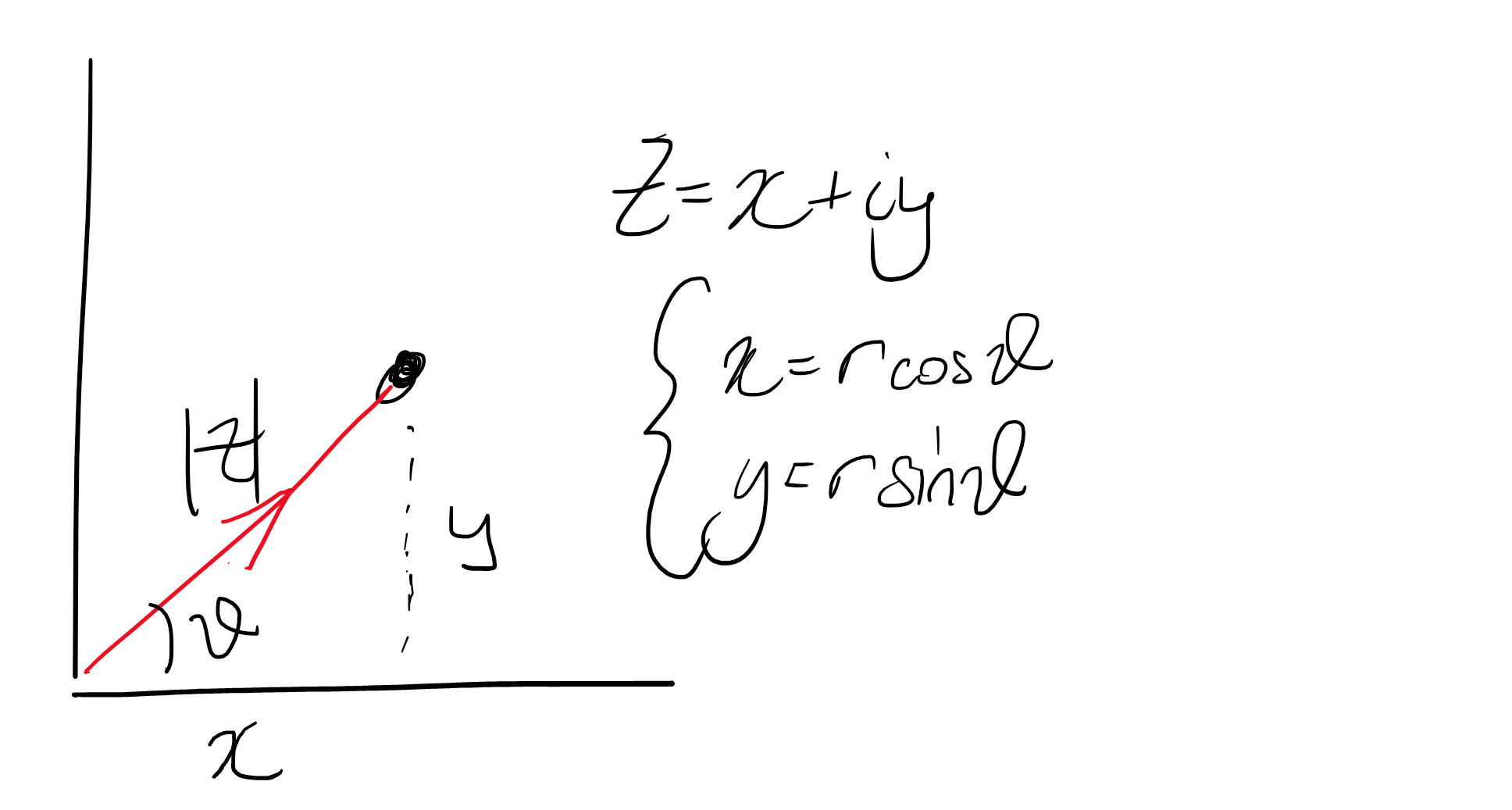
The complex conjugate is defined as a function \bar \cdot : \Complex \to \Complex, where (x + iy) \mapsto (x - iy). Geometrically, this reflects a complex number about the real axis.
Properties
\begin{aligned}
z = \bar z \iff \operatorname{Im}(z)&= 0 \text{ (i.e. z} \in \mathbb R \text{)} \\
\overline {(\bar z)} &= z \\
\overline {zw} &= \bar z \bar w \\
\overline{z+w} &= \bar z + \bar w \\
\overline {z^{-1}} &= (\bar z)^{-1}, z \ne 0 \\
|z|^2 &= z \bar z \\
\operatorname{Re}(z) &= \frac{z + \bar z} 2 \\
\operatorname{Im}(z) &= \frac{z - \bar z} 2
\end{aligned}
A very useful property (from MATH1051) is the triangle inequality:
|z+w| \le |z| + |w|.
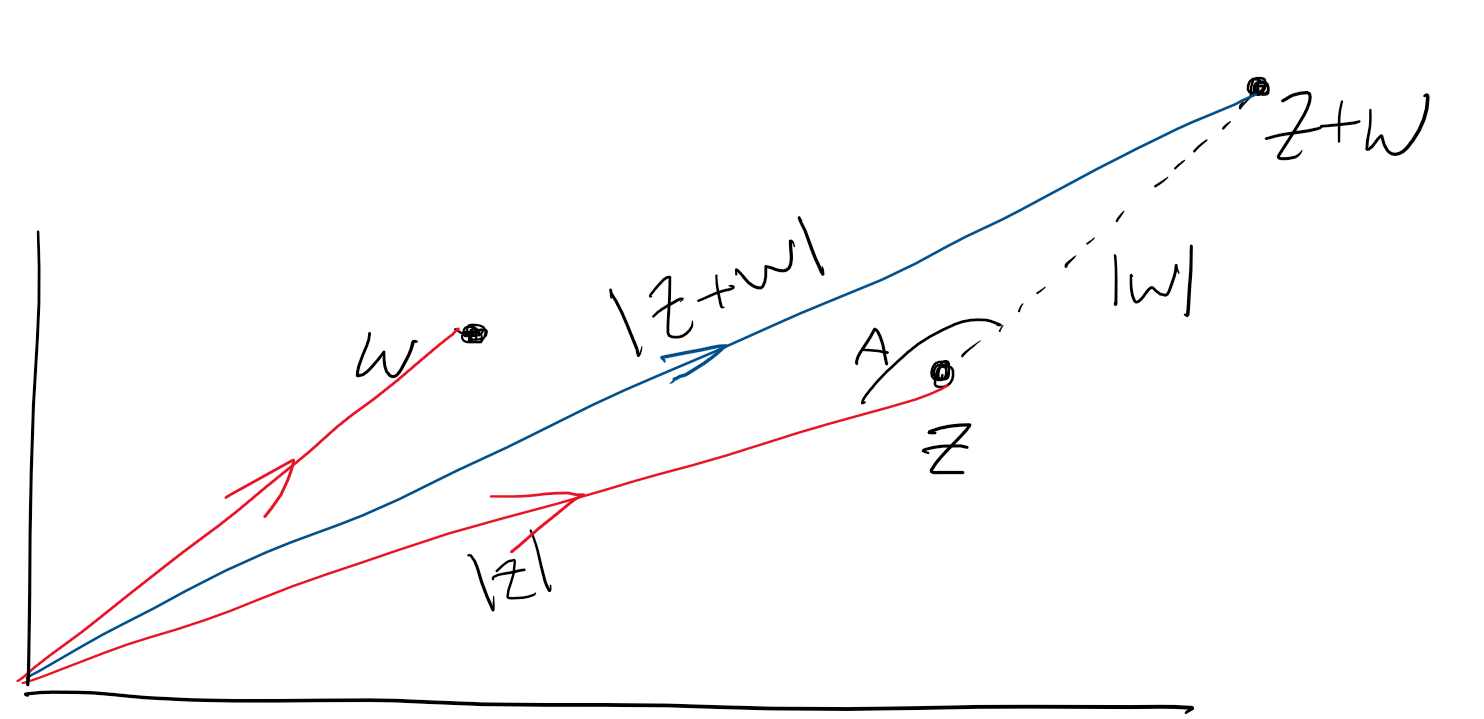
Proof: More specifically using the cosine rule,
|z+w|^2 = |z|^2 + |w|^2 - 2|z||w|\cos A.
This is a true and exact statement. However, in analysis, we often want to make these statements less precise but more useful. Because -1 \le \cos \le 1,
\begin{aligned}
|z+w|^2 &\le |z|^2 + |w|^2 + 2|z||w| \\
&= (|z| + |w|)^2\\
\implies |z+w| &\le |z| + |w|
\end{aligned}
Polar coordinates
B.C. 6-9
Given a complex number z = x+iy, we can find r and \theta such that
x = r \cos \theta, \text{ and }\ y = r \sin \theta.
Then, we can also write it using Euler’s formula (as a formal convention for the moment):
z = re^{i\theta} = r(\cos \theta + i \sin \theta).
Remark: this formula follows formally from the Taylor series of e^{i\theta}.
Here, \theta is an (as opposed to the) argument of the complex number z. We write \theta = \arg z. Here, \arg is not a (single-valued) function. Given a \theta, we can always take \theta + 2\pi which will satisfy the x and y equations. Also, for z=0, any \theta will work.
To make \arg a function, we need to restrict its range. There are two options: 0 to 2 \pi and -\pi to \pi. In complex analysis, we normally use the second. Specifically, \operatorname{Arg} z is defined to be the unique values of \theta such that -\pi < \arg z \le \pi.
Examples: - \operatorname{Arg}(1+i) = \pi / 4 but \arg (1+i) = \ldots, -7\pi/4, \pi/4, 9\pi/4, \ldots. - \operatorname{Arg}(-1) = \pi. - \operatorname{Arg}(0) is undefined, but \arg (0) = \mathbb R.
In summary, \operatorname{Arg} is a function \mathbb C \setminus \{0\} \to (-\pi, \pi]. Alternative notation for \mathbb C \setminus \{0\} is \mathbb C^* or \mathbb C_*.
Note:
\begin{aligned}
|e^{i\theta}| &= 1 \text{ (easy to check)}\\
(e^{i\theta})^{-1} = e^{-i\theta} &= \overline {e^{i\theta}} \\
(re^{i\theta})(\rho e^{i\phi}) &= (r\rho) e^{i(\theta + \phi)} \\
\implies |zw| &= |z| |w|,\enspace \arg (zw) + \arg z \arg w
\end{aligned}
However, the last equality does not necessarily hold for \operatorname{Arg}. For example, with z = w = {(-1 + i)/\sqrt 2}
De Moivre’s formula
z = re^{i\theta} \implies z^n = r^n e^{in\theta}, \quad n \in \mathbb Z.
In particular,
e^{in\theta} = (\cos \theta + i \sin \theta)^n = \cos(n\theta) + i \sin (n\theta).
 Proof: More specifically using the cosine rule,
|z+w|^2 = |z|^2 + |w|^2 - 2|z||w|\cos A.
This is a true and exact statement. However, in analysis, we often want to make these statements less precise but more useful. Because -1 \le \cos \le 1,
\begin{aligned}
|z+w|^2 &\le |z|^2 + |w|^2 + 2|z||w| \\
&= (|z| + |w|)^2\\
\implies |z+w| &\le |z| + |w|
\end{aligned}
Proof: More specifically using the cosine rule,
|z+w|^2 = |z|^2 + |w|^2 - 2|z||w|\cos A.
This is a true and exact statement. However, in analysis, we often want to make these statements less precise but more useful. Because -1 \le \cos \le 1,
\begin{aligned}
|z+w|^2 &\le |z|^2 + |w|^2 + 2|z||w| \\
&= (|z| + |w|)^2\\
\implies |z+w| &\le |z| + |w|
\end{aligned}