Recall that T(z) = w = \frac{az+b}{cz+d} (ad-bc \ne 0) is a Möbius transformation.
It can be rewritten as Azw + Bz + Cw + D = 0 where A = c, B = -a, C=d, D=b. This is called the implicit form.
Recall that case 1 was c = 0, which reduces T to a linear transformation which is a bijection \mathbb C \to \mathbb C. Case 2 was also a bijection from \mathbb C \setminus \{-d/c\} \to \mathbb C \setminus \{a/c\}, with inverse T^{-1}(w) = \frac{-dw+b}{cw-a}.
A question might be can we extend T to a function \mathbb C \to \mathbb C in case 2? In particular, such that the extension is injective and surjective. The answer is yes, by “plugging the hole”. We simply define T(-d/c) = a/c. However, this is unsatisfying because the function becomes discontinuous.
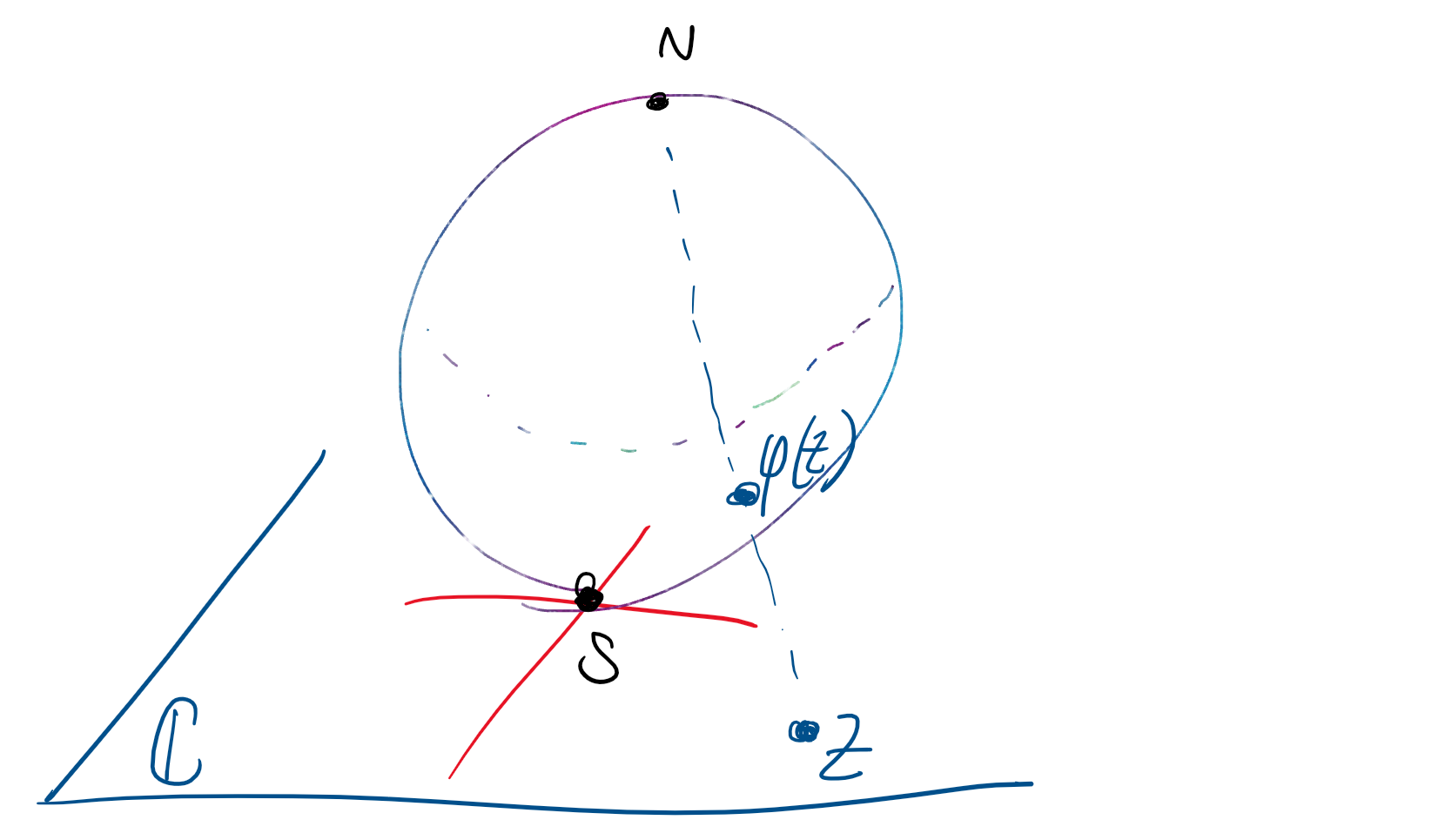
An important concept: We are going to extend \mathbb C to the extended complex plane, written \bar{ \mathbb C}. This is done by adding a point at infinity, which is called \infty. We can think of the complex plane as a sphere with the origin at one pole and this \infty at the other, with distances expanding as you go further from 0.
We then define T(-d/c) = \infty and T(\infty) = a/c. This extends T to a map \bar {\mathbb C }\to \bar {\mathbb C} which is injective and surjective.
Remark: \bar {\mathbb C} is a topological space and the above extension is continuous. A topology on a set is a space with so-called “open sets”. Intuitively, points can be ‘nearby’ to other points.
\bar {\mathbb C} can be visualised as the Riemann sphere. The origin 0+0i is at the south pole. A point on the complex plane is mapped uniquely to a point on the sphere. This is done by picking the point on the sphere’s surface on the line between the point and the north pole. “Infinity” can be thought of as the north pole.
A few final remarks on Möbius transformations. Given 3 distinct points in z_1, z_2, z_3\in\bar{ \mathbb C} and 3 different distinct points w_1, w_2, w_3 \in \bar {\mathbb C}, there exists a unique Möbius transformation T such that T(z_1) = w_1, \ T(z_2)=w_2, \text{ and }T(z_3)=w_3. In fact, T is given by \frac{(w-w_1)(w_2-w_3)}{(w-w_3)(w_2-w_1)} = \frac{(z-z_1)(z_2-z_3)}{(z-z_3)(z_2-z_1)}. In practice, it may be easier to directly solve for a,b,c,d than using the above expression.
Note: How does this work with infinity? \begin{aligned} T(\infty) = a/c &\iff \lim_{|z|\to\infty} T(z) = a/c\\ T(-d/c) = \infty &\iff \lim_{z\to -d/c} 1/T(z) = 0 \end{aligned}