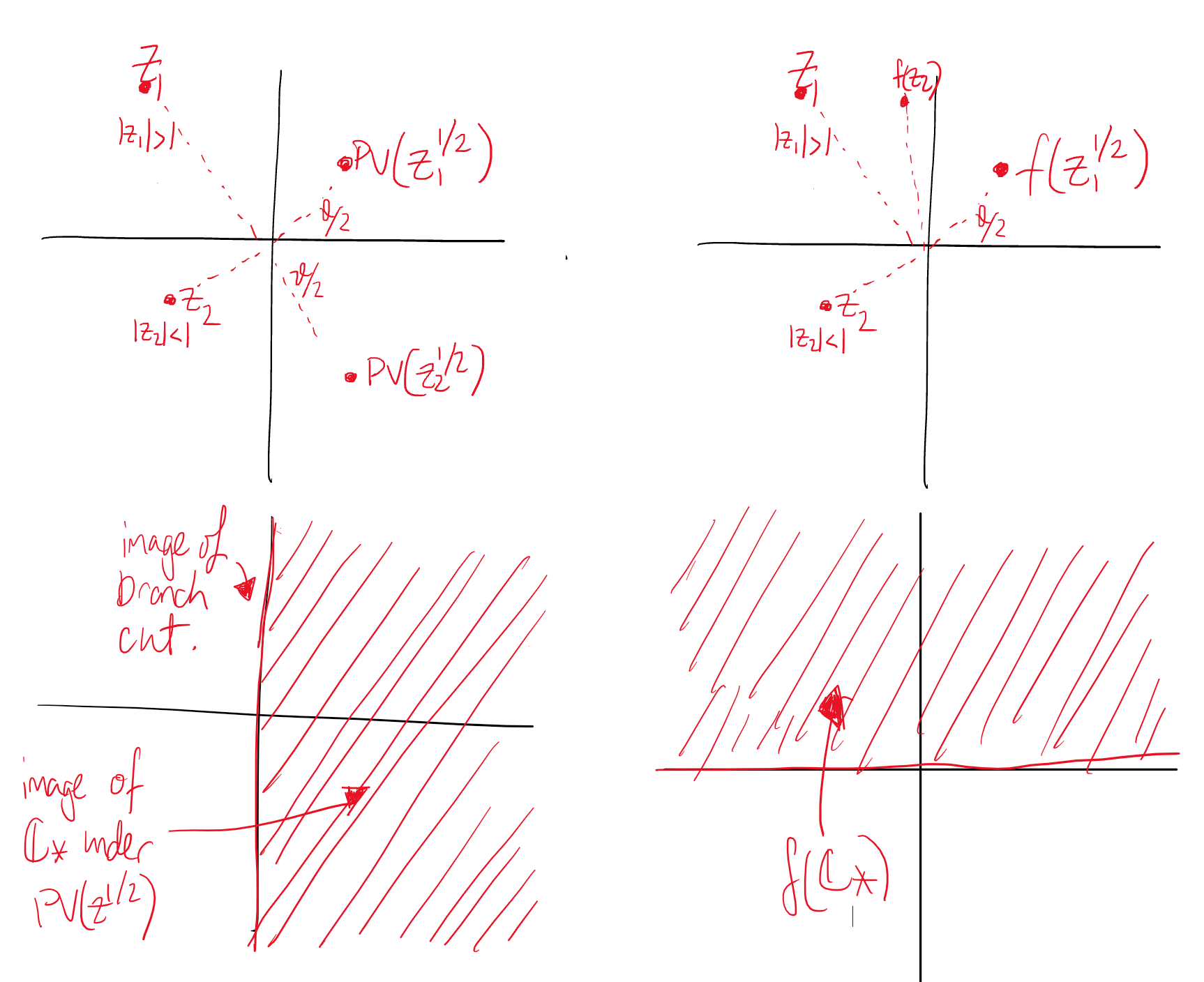
 Exercise: Repeat for (z-z_0)^{1/2}.
B-C 108.
A branch is a half-open interval of the form \alpha \le \theta < \alpha + 2\pi or \alpha < \tilde \theta \le \alpha + 2\pi of \mathbb R.
This is good because we can define a single-valued \operatorname{Arg} with values in this interval, a single-valued \operatorname{Log}, as well as a single-valued branch of, for example, z^{1/2}.
A branch cut is a subset of \mathbb C, of the form \{z : \arg z = \alpha\}\cup \{0\}. This is where a particular branch is discontinuous.
For example, \operatorname{PV}(z^{1/2}) which maps \begin{aligned} z &\mapsto |z|^{1/2} \exp \left(\frac{i\operatorname{Arg}z } 2\right) \\ re^{i\theta}&\mapsto \sqrt r \exp(i\theta/2) \end{aligned} The branch is -\pi < \theta \le \pi and the branch cut is the negative real axis union with zero.
Consider the behaviour of z \mapsto z^{1/2} under two different branches, -\pi < \theta \le \pi and 0 \le \theta < 2\pi. Exercise: Repeat for (z-z_0)^{1/2}.
B-C 37-39 (8Ed 34-35)
For x \in \mathbb R, \begin{aligned} e^{ix} &= \cos x + i\sin x \\ e^{-ix} &= \cos x - i \sin x\\ \implies \cos x &= \frac{e^{ix}+e^{-ix}}2\\ \implies \sin x &= \frac{e^{ix}-e^{-ix}}{2i} \end{aligned} We can use these expressions to define \cos and \sin on \mathbb C. Specifically, \cos z = \frac{e^{iz}+e^{-iz}}2\quad \text{and}\quad \sin z = \frac{e^{iz}-e^{-iz}}{2i}. This gives us the following properties: - \cos z = \cos (-z) - \sin z = - \sin (-z) - \cos(z+\xi) = \cos z \cos \xi - \sin z \sin \xi - \sin (z+\xi) = \sin z \cos \xi + \cos z \sin \xi - \sin^2 z + \cos^2 z = 1 (this does not imply that they are bounded in \mathbb C) - \sin (z+\pi/2) = \cos z - \sin (z-\pi/2) = -\cos z (these two proven using properties of exp)
On \mathbb R, the hyperbolic functions were \sinh x = \frac{e^x-e^{-x}}2\\ \cosh x = \frac{e^x + e^{-x}}2 Recall that \sinh is somewhat like a exaggerated cubic and \cosh is not unlike a steeper periodic parabola. Also, \cosh can be used to model a hanging cable with weight.
Similarly to the first trig functions, we can define the hyperbolic functions on \mathbb C as \cosh z = \frac{e^{z}+e^{-z}}2\quad \text{and}\quad \sinh z = \frac{e^{z}-e^{-z}}{2}. Interestingly, \sin (iy) = i \sinh y \quad \text{and}\quad \cos(iy) = \cosh y. Tke z = x and \xi = iy in the sum formulas and we get \begin{aligned} \sin(x+iy) &= \sin x \cos(iy) + \cos x + \sin (iy)\\ &= \sin x \cosh y + i \cos x \sinh y\\ \cos(x+iy) &= \cos x \cosh y - i\sin x \sinh y \end{aligned} Together, the two above equalities imply \sin(z+2\pi) = \sin z and \cos(z+2\pi) = \cos z. Additionally, we have \cosh^2 z = 1+\sinh^2 z and \begin{aligned} |\sin z|^2 &= \sin^2 x \cosh^2 y + \cos^2 x \sinh^2 y \\ &= \sin^2 x(1+\sinh^2y) +(1-\sin^2x)\sinh^2 y\\ &= \sin^2 x + \sinh^2 y\\ |\cos z|^2 &= \cos^2x + \sinh^2 y \end{aligned}
Recall that a function f : \Omega \to \mathbb Z is called bounded if there exists M such that |f(z)| \le M for all z \in \Omega. Note that there can exist unbounded functions with finite area.
Finally, \sin and \cos are unbounded on \mathbb C, because with a sufficiently large imaginary component they can become arbitrarily large.